 The Hollywood Outsider – Film and Television Podcast | Reviews An award-winning film and television podcast for the fan in all of us
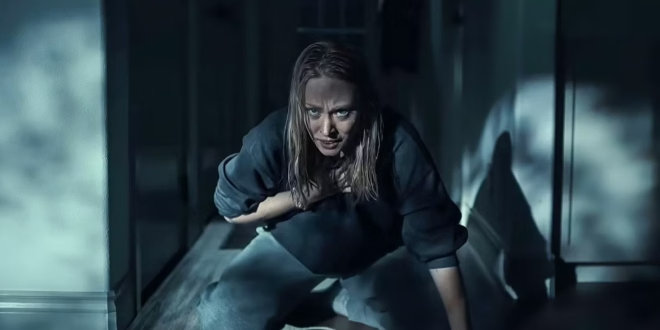
Horror loves to revisit familiar territory, but every so often, a film finds a way to make the old tricks feel frighteningly fresh. Shudder’s The Cycle is exactly that kind of surprise. It takes a premise that could easily have descended into familiar genre territory and instead delivers a creepy, atmospheric experience that knows precisely how to get under your skin.
Blending the suffocating atmosphere of The Autopsy of Jane Doe with the mythology of a creature feature, The Cycle delivers an unsettling experience that understands the difference between showing you a monster and making you dread what might be lurking just beyond your understanding. I don’t want to give too much away, but you’ll understand what is happening pretty early on. Or at least, you think you do. And that distinction is where much of the film’s appeal lies. The Cycle gives you enough information to start putting the pieces together, then leaves you questioning whether the picture you’re assembling is actually the one staring back at you.
There is something inherently unnerving about a horror story that begins with a body and a scientific investigation. We want answers. We want explanations. We want someone in the room who understands the facts and can tell us precisely what we are looking at. But horror has a nasty habit of taking those expectations, throwing them into a wood chipper, and asking us to reconsider our relationship with the things we thought we understood. The Cycle plays with that discomfort, using its central mystery to create an escalating sense of dread without feeling the need to constantly announce that something terrifying is happening.
The setup also gives the film a compelling emotional hook. A father missing for more than three decades is already a mystery worth investigating, but bringing his daughter Meg (Deborah Ann Woll) into the equation adds another layer to the proceedings. This is not simply a matter of identifying a body or explaining an inexplicable discovery. There is a personal connection to the horror, and that makes the increasingly bizarre circumstances more compelling. When the investigation begins pushing into territory that most people would dismiss as completely insane, the question becomes whether the evidence is genuinely pointing toward something extraordinary or whether the people involved have lost their grip on reality.
Woll and Jeffrey Donovan as driven detective Marks anchor the film with restrained yet increasingly intense performances, allowing the tension to build naturally rather than relying on the usual horror histrionics. There is an uneasiness to their approach and director Jordan Downey’s lens that makes the film’s darker turns all the more effective. Woll brings a grounded intelligence to a character whose scientific background makes the increasingly unbelievable circumstances all the more fascinating. She is not simply reacting to strange events because the screenplay needs someone to scream at the appropriate moment. She is trying to understand what she is seeing, even as the possibility of an explanation becomes more disturbing than the mystery itself.
Donovan provides an effective counterbalance, particularly as the investigation moves beyond what anyone would reasonably consider normal. His character’s eventual willingness to entertain her increasingly outrageous theory gives the story another interesting dimension. In a lesser film, that shift might feel like a convenient shortcut to getting the plot where it needs to go. Here, the performances help sell the growing uneasiness, allowing the audience to follow the characters into increasingly uncomfortable territory without completely abandoning its own skepticism.
And that is important because The Cycle works best when it leaves room for uncertainty. The film understands that explaining every strange occurrence can be just as damaging as explaining nothing at all. Horror thrives on the space between what we know and what we fear, and Downey seems to understand that the audience’s imagination can be far more effective than an endless parade of visual effects and monster close-ups.
That atmosphere is a major reason the film works. The Autopsy of Jane Doe remains an excellent example of how a confined setting, a compelling mystery, and a steadily escalating sense of wrongness can create genuine tension. The Cycle taps into a similar vein of discomfort while introducing its own creature mythology. The result feels familiar enough to draw you in but unusual enough to keep you interested in where the story might go. It is not necessarily about reinventing horror so much as finding a different way to make its familiar ingredients taste wonderfully unsettling.
The Cycle takes a frequently explored genre and finds something intriguing lurking beneath the surface. It is atmospheric, unsettling, and a welcome reminder that horror does not need to reinvent the wheel when it can simply make that wheel feel like it is rolling straight toward you. The film’s greatest strength is its ability to make a relatively straightforward investigation feel increasingly dangerous, relying on mood, performances, and the slow erosion of certainty rather than nonstop shocks.
Is it going to redefine horror or send every other creature feature scrambling back to the drawing board? No. But that is an awfully high bar for any film to clear, and The Cycle does not need to clear it to be worthwhile. It delivers an intriguing premise, a creepy atmosphere, and performances that give its increasingly strange story a solid human foundation. Sometimes, that is exactly what a horror fan needs.
The Hollywood Outsider Film Review Score
Performances - 7.5
Screenplay - 6.5
Production - 7
7
The Cycle delivers an indie horror treat worthy of adding to your Halloween rotation.
Starring Deborah Ann Woll, Jeffrey Donovan
Screenplay by Jordan Downey and Kevin Stewart
Directed by Jordan Downey